Mastering the Amazon Software Engineer Interview: Questions, Process, and Expert Tips for Preparation
As one of the world’s leading tech giants, Amazon is known for its high standards and difficult hiring process. In this article, we’ll be showing you what to expect during a software engineer interview at Amazon and what you should do to prepare.
Just like Meta, Amazon is a dream destination for many software engineers. Thorough preparation is essential, starting with familiarising yourself with Amazon’s Leadership Principles (LPs). We’ll be discussing those, as well as the process, commonly asked questions, and our tips.
Table of Contents
- The Amazon Interview Process and Timeline
- Common Amazon Software Engineer Interview Questions
- Mistakes to Avoid During Amazon’s Interviews
- What Happens After the Amazon Interview?
- FAQ
- Conclusion
The Amazon Interview Process and Timeline
Amazon’s interview process consists of three steps: the recruiter call or online assessment, the technical phone screen, and the onsite. The OA will last about 90 minutes, the recruiter call about 30 minutes, the technical phone screen 30 to 60 minutes, and the onsite will last at least 4 hours. In those 4 hours, you’ll have at least 1 behavioural interview, 3 coding interviews, 1 system design interview, and 1 chat with a hiring manager.
Online Assessment or Recruiter Screen
Depending on if you have previously worked at a FAANG or if you’ve previously interviewed at Amazon or if you’re completely new, you’ll have a recruiter call or Online Asessement. Recruiter calls being used with more mid- to senior-level engineers, and OA’s being used with junior engineers. Though recently Amazon seems to be using OAs more frequently with all tiers to test competencies of junior engineers as well as senior engineers.
The Online Assessment is a timed test consisting of multiple coding problems, conducted via HackerRank. These are usually easy to medium difficulty questions, consisting of algorithm problems and data structures. The system design questions are a few multiple-choice questions where you’ll select the best option for the situation presented.
The recruiter screen won’t differ much from any other recruiter screen, with questions such as why you want to work at Amazon, what your previous experience is, and what your salary expectations are. It’s important to not mention too much about your salary expectations and your history because of negotiations further down the line.
Technical Phone Screen
The next step in your interview process is the technical phone screen, which at Amazon primarily focuses on data structures and algorithms. Amazon uses an internal tool called Livecode, which has syntax highlighting for commonly used languages but does not have the ability to run the code you put out.
In most cases, you’ll be asked to solve one leetcode question for which you have 30 to 40 minutes. These are typically medium-level coding problems similar to what you’ve practiced on HackerRank or LeetCode. We recommend practicing daily and trying out different types of problems.
There’s a small chance that you’ll be asked one or two Leadership Principles questions. If that doesn’t happen during your technical screen, it’ll definitely happen during your onsite.
Onsite Interview
If you perform well on the technical phone screen, you’ll be invited to an onsite or in-person interview. The Amazon included multiple coding rounds and will generally last about 4 hours. It includes:
- At least one behavioral round
- Three coding rounds
- One system design round
- One hiring manager round
- During your onsite interview, you’ll run into what Amazon calls Bar Raisers. These are senior-level Amazon employees who are highly skilled interviewers. They are brought into an interview as an objective third party to ensure that the hiring decision is not influenced by the candidate's department or immediate team.
They’ll ask follow-up questions. To get the best results out of an interview, Bar Raisers at Amazon recommend the following:
- Go beyond your resume: Tell them something that they can’t learn from your resume.
- Familiarise yourself with Amazon’s Leadership Principles: the 16 leadership principles are key for working at Amazon. Build your stories around them.
- Practice, practice, practice: Try out mock interviews or find someone to practice interviews with and record yourself answering questions. Don’t be afraid of feedback.
- Learn from your mistakes: be self-critical and demonstrate what you’ve learnt from failure. Mention how it impacted you or how it changed your approach to work.
- Show your value: Give out examples that show your added value, but also end your response with a result.
- Ask questions: let the interview be more of a conversation as opposed to an interrogation. Ask questions you want to know the answers to.
- Show your personality but stay professional: don’t overshare, but be yourself.
Common Amazon Software Engineer Interview Questions
Coding Questions During the phone screen and onsite, you’ll have coding rounds. The onsite is very similar to the technical phone screen. The only difference being that during the onsite, you will get Leadership Principles questions, whereas during the phone screen you might get them.
Amazon mostly asks medium leetcode-style questions and usually avoids hard questions. This to let the candidate demonstrate how quick they can get to an optimal result. Amazon is focusessed on putting out new features quickly and actively seeks engineers who can do so.
Despite the focus on speed, Amazon will ask complex problems that requires a lot of code, and the time allowed is usually 30-40 minutes, which means in most cases you get one question, as opposed to Meta, where you might get multiple questions.
During the coding round Amazon tests mainly computer science fundamentals and knowledge of data structures and algorithms and the candidate's ability to write logical and maintainable code.
Because you can’t run code during your Amazon interview, the approach, speed and testing is more important than variable naming and edge cases.
Amazon commonly asks:
- Graph questions
- Tree questions that require BFS or DFS
- Classic questions like LRU cache, word break, meeting rooms and word ladders
System Design Questions During your system design interview you’ll likely be asked 1 or 2 Leadership Principles questions as well as the system design questions. Efficiency is key here.
Amazon is known for asking practical system design questions. If you’re at any point stuck and don’t know what to talk about, talk about performance.
Commonly asked system design questions include:
- Design autocomplete
- Design file upload/download to the cloud
- Design search
The design questions are about designing well-known features, as opposed to a complete system from scratch like Design Facebook or Twitter. Amazon interviewers are free to ask whatever they want in the system design round, but many interviewers reuse questions from Amazon’s question bank.
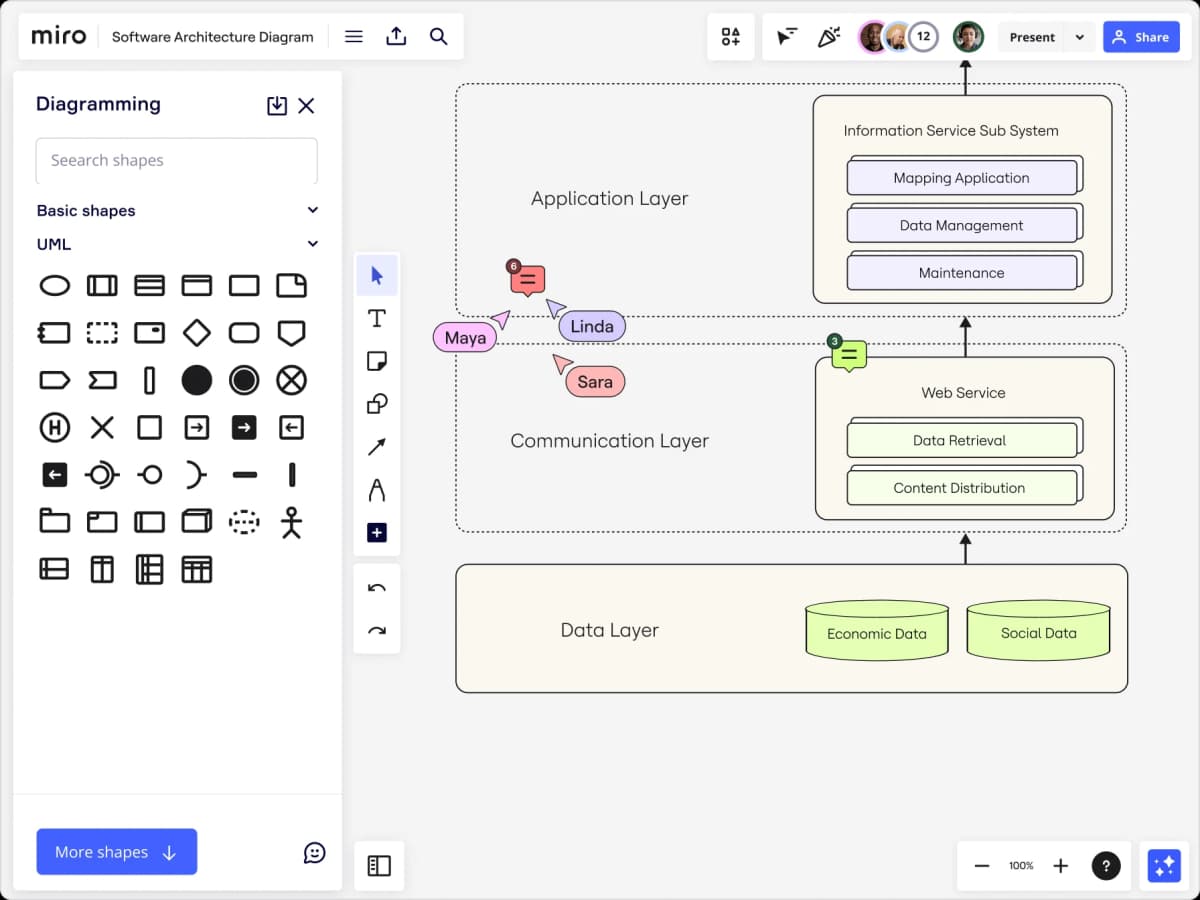
For tooling in system design interviews, candidates are free to use any type of drawing tool. Excalidraw is most popular, followed by Miro.
Behavioral Questions and Leadership Principles
Because of the Leadership Principles, the behavioral interview is one of the most important in terms of leading to an offer at Amazon. Even if your technical interview didn’t go as planned, the behavioral can still get you pushed over the line. It’s important to prepare for the behavioral round. During the behavioral they will always focus on your work history. Based on your answers and how well you demonstrate their Leadership Principles, Amazon will decide whether or not to hire you.
Each interviewer has their own way of determining whether you as a candidate are a good fit.
In the behavioral round, expect questions from the following categories:
- Technical problem solving
- Learning (and failure)
- Getting stuff (for the business) done
- Interpersonal conflict
- Ambiguity
Amazon’s Leadership Principles (LPs) are the 16 values Amazon cares about most, developed by Jeff Bezos. A quick overview with example questions:
1. Customer Obsession - Tell me about a time when you disagreed with your manager or peer on something you considered very important to the business. - Tell me about a time when you overcommitted yourself or your company.
2. Invent and Simplify - Tell me about a time when you didn't meet customer's needs. - Give me an example of a difficult problem you solved with a simple solution.
3. Learn and Be Curious - Give an example of something that you’ve worked on the improve your overall work effectiveness.
4. Insist on the Highest Standards - Tell me about a time when you had to work with a difficult customer or user. - Tell me about a time when you used external trends to improve your own company's products or services.
5. Deliver Results - Tell me about a time where you had to take on more responsibility over a project. - Tell me about a decision ou had to make without clear benchmarks.
6. Strive to be the Earth’s Best Employer (irrelevant for software engineers)
7. Dive Deep - Tell me about a time when you had to communicate a change of direction that you thought people would have concerns with. - Tell me about a time where you were put onto a project where you had no experience in.
8. Have Backbone; Disagree and Commit - Give me an example of a time you committed to a group decision even though you disagreed. - Tell me about a time where you disagreed with a coworker or manager because you thought the decision they wanted to make was wrong for the customer.
9. Success and Scale Bring Broad Responsibility (only relevant for managers)
10. Ownership - Describe a time when you took on work outside of your comfort area. - Describe a situation where you made an important decision without consulting your manager.
11. Are Right, A Lot - Tell me about a time when you did not effectively manage your projects and something did not get completed on time. - Tell me about a time you wouldn't compromise on achieving an outcome when others felt something was good enough.
12. Hire and Develop the Best - Tell me about a time when you received negative feedback. - Describe a time when you improved morale and productivity on your team.
13. Think Big - Give an example of an idea you had that proved really difficult to implement. - Tell me about a time where you encouraged someone to take a risk.
14. Bias for Action - Tell me about a calculated risk you’ve taken where speed was critical. - Tell me about a time where you were the first one to take action.
15. Frugality - Tell me about a time where you pushed back on a deadline. - Tell me about a time where you helped save costs within your role.
16. Earn Trust - Tell me about a time where you had a disagreement with a colleague.
Mistakes to Avoid During Amazon’s Interviews
Avoid these mistakes to increase your chances of acing Amazon's interview process and standing out as a strong candidate.
1. Neglecting Amazon’s Leadership Principles
Many candidates focus only on technical skills and overlook behavioral questions. As mentioned before, Amazon highly prioritises its Leadership Principles, and failing to prepare examples that demonstrate these principles won’t work in your favor.
2. Rushing Through Problem-Solving
Jumping straight to coding without clearly explaining your thought process can be detrimental. Interviewers are as interested in how you approach problems as they are in the final solution. Take your time to outline your approach before coding.
3. Underpreparing for System Design Questions
For senior or experienced roles, system design questions are critical. A vague or unscalable design can signal a lack of depth in architectural thinking. Practice designing systems with scalability, fault tolerance, and efficiency in mind.
4. Failing to Communicate Effectively
Staying silent while solving a problem or failing to ask clarifying questions can create misunderstandings. Verbalizing your thought process and engaging with the interviewer shows collaborationcommunicationation skills.
5. Ignoring the Importance of Mock Interviews
Overconfidence can lead to underestimating the value of practice. Skipping mock interviews or real-time problem-solving sessions can leave you unprepared for the actual interview dynamics.
What Happens After the Amazon Interview?
After the interview, Amazon will most likely respond within 5 – 10 business days with either an offer or a rejection. We recommend being patient and not bombarding your recruiter with messages. If you haven't heard back after more than two weeks you can send them a friendly follow-up.
Frequently Asked Questions
1. What are the main stages of Amazon's software engineer interview process?
The interview process typically consists of a recruiter call or online assessment, a technical phone screen, and an onsite interview. The onsite includes multiple rounds: coding interviews, a system design interview, a behavioral interview focused on Amazon's Leadership Principles, and a chat with the hiring manager
2. What types of coding questions should I expect during Amazon’s technical interviews?
Candidates are usually asked medium-level coding questions that test their knowledge of algorithms and data structures, such as graph problems, tree traversal using BFS/DFS, or classic questions like LRU Cache and Meeting Rooms. Amazon focuses on practical problem-solving and logical code.
3. How should I prepare for the behavioral interview at Amazon?
Prepare stories that highlight your skills and align with Amazon’s 16 Leadership Principles. Use the STAR (Situation, Task, Action, Result) method to structure your responses and practice explaining how your experiences demonstrate customer obsession, ownership, and other key principles.
4. What system design topics are commonly covered in Amazon interviews?
For senior roles, Amazon often asks practical system design questions such as designing autocomplete, file upload/download systems, or search functionality. Candidates should focus on scalability, fault tolerance, and performance optimization during these discussions.
5. How long does it take to hear back from Amazon after the interview?
Amazon typically responds within 5–10 business days after the interview with either an offer or feedback about the next steps.
Conclusion
Landing a software engineering role at Amazon requires thorough preparation, technical expertise, and a strong understanding of the company’s unique culture and Leadership Principles. By familiarizing yourself with Amazon’s Leadership Principles, practicing data structure and algorithm problems, and keeping your system design skillsup to date, you can improve your chances of success. Don’t overlook the importance of the behavioral interview, as it plays a significant role in the hiring decision.
Throughout the process, focus on clear communication, thoughtful problem-solving, and showcasing your ability to add value to Amazon's fast-paced environment. Avoid common pitfalls like neglecting leadership principles, underpreparing for system design, and skipping mock interviews.
With determination and consistent practice, you can approach Amazon’s rigorous interview process with confidence and increase your chances of securing a role at one of the most innovative companies in the world. Good luck, and when in doubt, use Phantom Code!